Gross to Net upload
For each payroll and pay period, a user with the appropriate upload permissions can upload data to the IPPEX system. Gross to net upload includes persistent and temporary post-processing pay entitlements, organisation unit values and payments. The gross to net upload process is similar to the pre-processing upload. The post-processing data is uploaded using the employee number as the key and the data columns are mapped to post-processing pay elements, organisation units and payment elements.
Any number of post-processing elements can be stored against a payroll. If an employee detail or pre-processing pay element does not exist for that payroll new elements can be created during the upload process. Organisation units values are validated against the permissible values stored for the client. Organisation unit values can also be uploaded with the post processing data upload (gross to net).
An employee has to be created against the payroll before payroll changes data can be uploaded to the employee on the payroll.
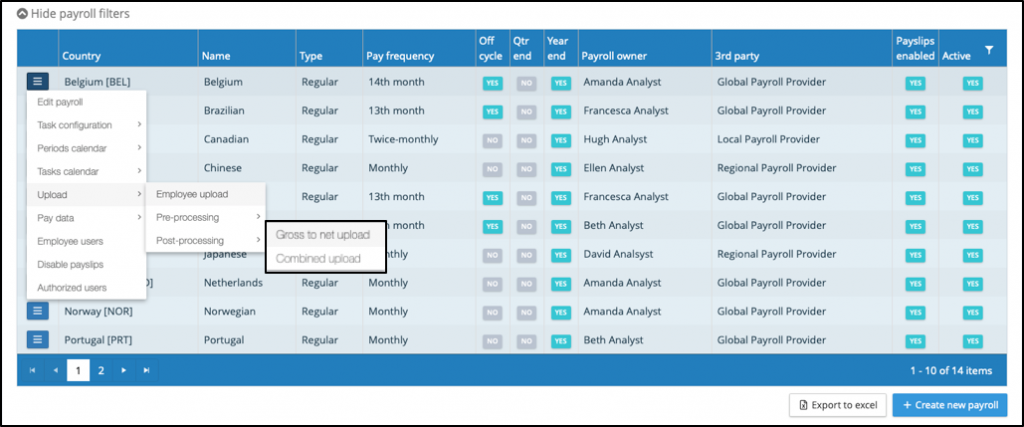
Pre-processing upload file format
Any data upload is performed using the employee number as the key to bind the employee details and pay element data to that employee. The file has to be a CSV UTF-8 format, the column headings can be in any order and do not have to match the pay elements in the IPPEX system. New pay elements are generated on the first upload. Data uploads can be broken down in to multiple files and uploads. The upload file must not have duplicate header names or special characters.

- Employee number is the key to employee upload
- The upload file can include employee attributes such as first name and last name, these are set to be ignored during the upload process.
- Any number of post-processing pay elements, if there is a new column heading (new data type) the corresponding pay element is created during the upload mapping process.
- Employee payments can be uploaded as part of the post processing upload.
- Organisation unit data can be uploaded as part of the post processing upload.
Pay Period Locking
Pay periods have a sequential locking process. Payroll gross to net data can only be uploaded to a payroll and pay period when the payroll changes upload has been locked. Likewise, the gross to net upload has to be locked before payroll changes data can be uploaded. The post-processing data can be unlocked, to upload more data and re-locked. Any user with upload permissions can lock a pay period, only those users with un-lock permissions can unlock a pay period.
When a pay period is unlocked, data and mappings can be deleted (a process called clear down) for a pre or post processing upload, there is specific page in the user guidance relating to clear down.
Locking the gross to net upload prevents any further uploads for this pay period of post-processing data.
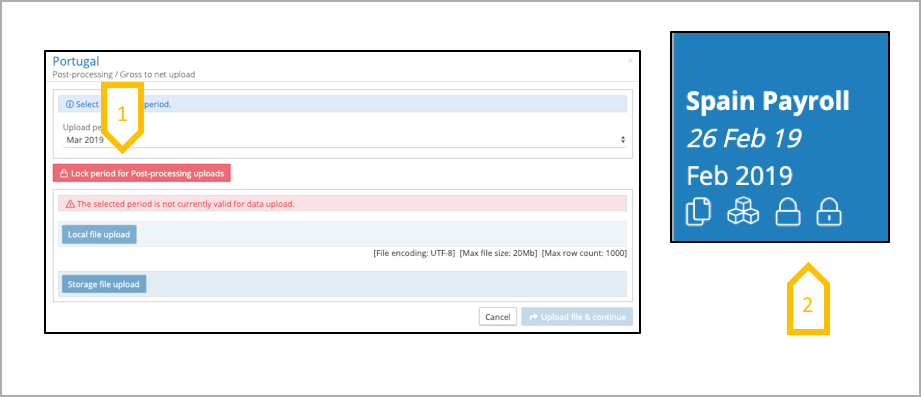
- To lock payroll gross to net upload, this will prevent any further uploads to this pay period for post-processing pay element data.
- Payroll dashboard shows two padlock symbols for a payroll and pay period, the first one indicate that the pre-processing has been locked and the second indicate the gross to net upload has been locked.
Initiating the post-processing upload process
The upload screen can be used for a number of functions, to upload payments, organisation units and/or post-processing pay data, it also allows the user to lock the pay period from further post-processing data uploads, it also enables you to delete payments, organisation unit values and pre-processing pay data previously uploaded to this pay period.
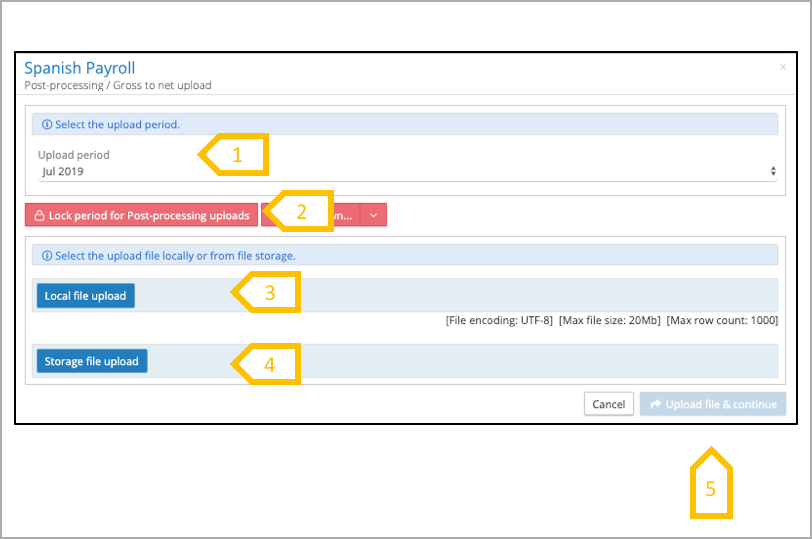
- Check that the upload is for the right pay period.
- If the payroll changes upload for this period has not be locked, the system will display a message in red, ‘this pay period is locked for upload’.
- Select a file from a local or network file system.
- Select a file from the IPPEX file system.
- When a file has been selected click on upload file and continue
Mapping the first upload to a payroll
All pay elements are local to a payroll. Pay elements do not need to be pre-defined globally and they do not need to be defined in advance of loading the post-processing data. Pay elements are created during the upload process. For organisation units and payments are covered in a separate slide.
The names given to the pay elements can reflect those held in an HCM system or those defined by the local gross to net system. Any number of language translations can be held against Employee details and pay elements names. On the initial upload to a payroll, the user has to give each new pay element a name, during this process the system creates a mapping between the pay element name and the column heading in the data file. This mapping is stored for all future uploads,
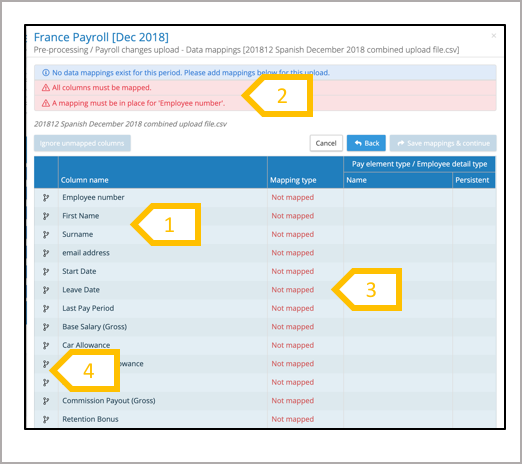
- These are the column headings from the upload file.
- Message states that all of column headings have to be mapped or ignored. That the employee number column in the upload file has to be mapped to the system employee number as this is used as the key to assign the data in the file to the employees.
- The system prompts the user to map the upload file column headings with a pay element, payment or organisation unit, for the initial upload, the user will be creating the pay elements for this payroll.
- Action button for creating the mappings
Mapping columns
Each column heading from the upload file has to be mapped to either a pay element, organisation unit or a payment with the exception of employee number and those columns of data that are going to be ignored for this upload. The system will retain the mappings selected for all future uploads. For all future uploads any unmapped columns will be highlighted in red, and can be mapped to an existing pay element or to create a new pay element, or mapped to an organisation unit and or payment.
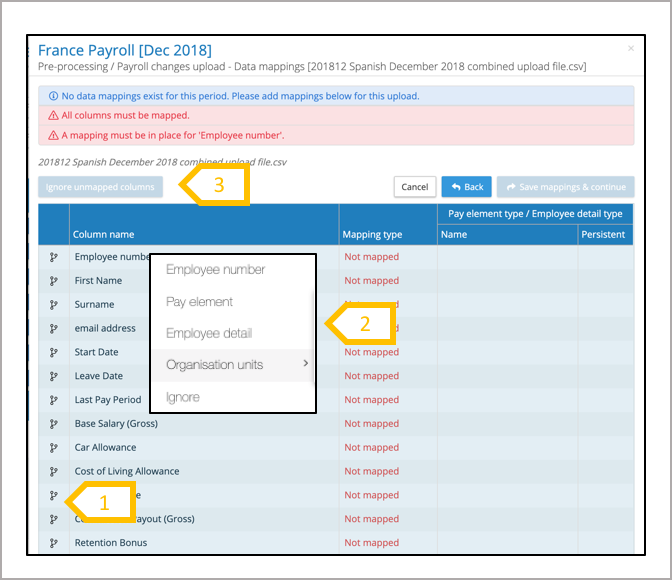
- Click on the mapping action button next to the column heading.
- Select the one of the mapping options, employee number, pay element, payments. Organisation units or ignore. Employee number can only be mapped to one column heading.
- When all of the elements which required to be mapped are completed, use ignore unmapped columns to ignore the remaining headings.
Mapping pay elements
For the initial upload of data (first pay period for this payroll), the user will be creating new elements for all the pay column headings. During future uploads if a column heading has changed from the last upload, it will require a new mapping to an existing element on the system. If there is a new column heading in a future upload, a new element will be required, however it is important to check that a pay element of this type has already been created.
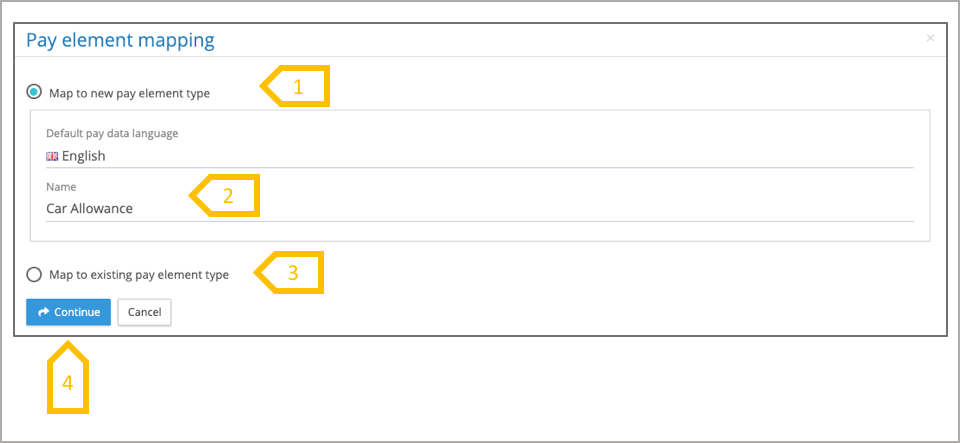
- The pay element mapping screen defaults to mapping to a new pay element.
- Creating a new element. Give the pay element a name, the system offers the column name from the upload file, overwrite this if you would like an alternative name, the new name cannot be the same as an existing element.
- Map to an existing pay element, a drop down list is presented.
- When the selection has been made, click on continue.
Mapping Organisation Units
Organisation units are enabled at the client tenancy level, for a given pay period organisation unit values can be uploaded against an employee. Organisation unit values are persistent, carried forward to the next pay period until changed or cleared. The data upload columns containing the organisation unit values have to be mapped to the appropriate organisation unit. During the upload process if a organisation unit value has not been defined in the unit permissible list, an error will occur and the value will not be stored for that individual.
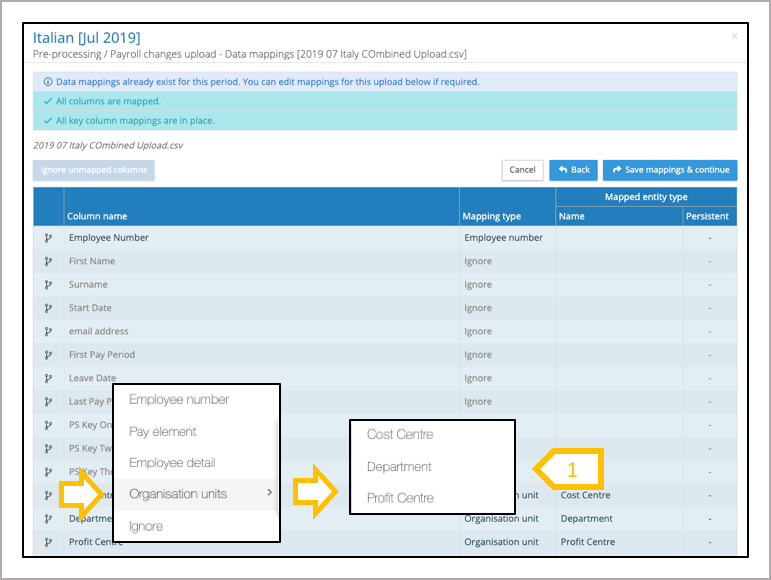
- Map upload heading to the appropriate organisation unit.
Mapping Payments
To make employee payments for a given pay period, values have to be uploaded to one of the payment elements. The process is the same as mapping a column to an organisation unit, in the case of payments there are two types, net pay and expenses.
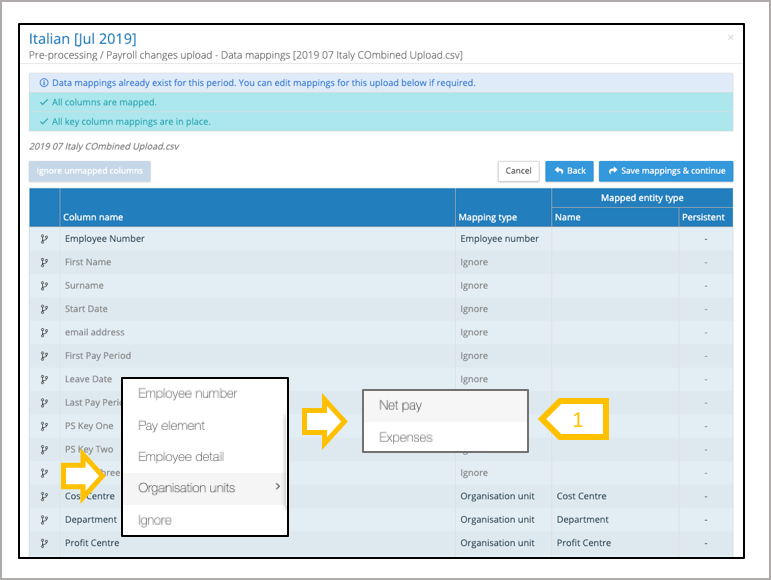
- Map upload heading to the appropriate payment.
Saving mappings and continuing with the upload process
When all of the column headings have been mapped or set to be ignored, The message will indicate that the user can proceed to the next stage of the upload process.
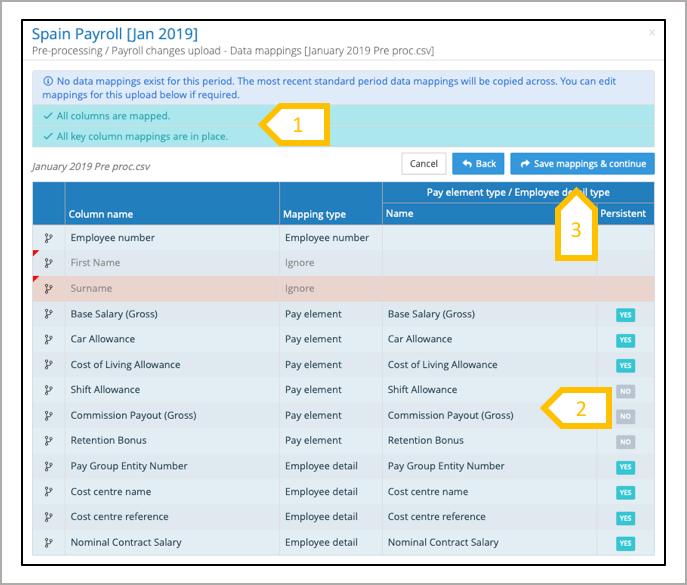
- Message saying all columns are mapped and all key column mappings are in place (employee number has been mapped)
- Before progressing the upload check that all of the columns have been mapped to the appropriate pay element, organisation unit or payment (or ignored). Progressing to the next stage of the upload process is when the new pay element are created. NOTE: When a pay element is created they cannot be deleted as data may be held against the element.
- Click on save mappings & continue, the system will store all of the current mappings for future uploads to this period and future periods.
Submit upload
The final step in the post-processing upload is to submit the upload. The data upload process is a background function, allowing the user to continue their work on other activities in the IPPEX system. When the upload process completes, the system will send an email notification providing an upload summary, stating if it was successful or if it failed.
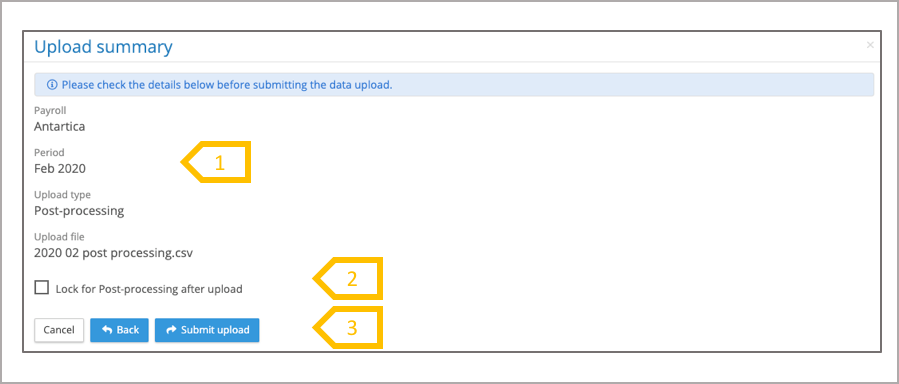
- Summary of upload, this is the last chance to check if the upload file Is correct and the upload is to the correct payroll and pay period.
- If this is the last of your post-processing data uploads to this period, there is an option to check the box to lock the post-processing period after the upload.
- If everything is correct, click on submit upload. The system will process the data in the background, sending a system generated email when the upload is complete.
Upload confirmation
When an upload is completed by the system, an email notification is sent to the user who performed the upload. The email summarises the file name uploaded, to which tenancy, payroll and pay period. It also states if the upload was successful. The system automatically stores a copy of the file uploaded, the details of the upload instructions and results of the upload, this is information can be found in files in an upload folder for the payroll and pay period.

- An upload process is can be one of the following: successfully completed, completed with errors or aborted.
- List of the client tenancy, payroll, pay period and file name uploaded to the system.
- Link to the upload results folder
Upload results
For each upload the system will create a new folder for the payroll and pay period, un uploads. The folder name has a date and time stamp when the upload process was completed. The folder contains three files, the upload instructions, the upload file and the results of the upload.
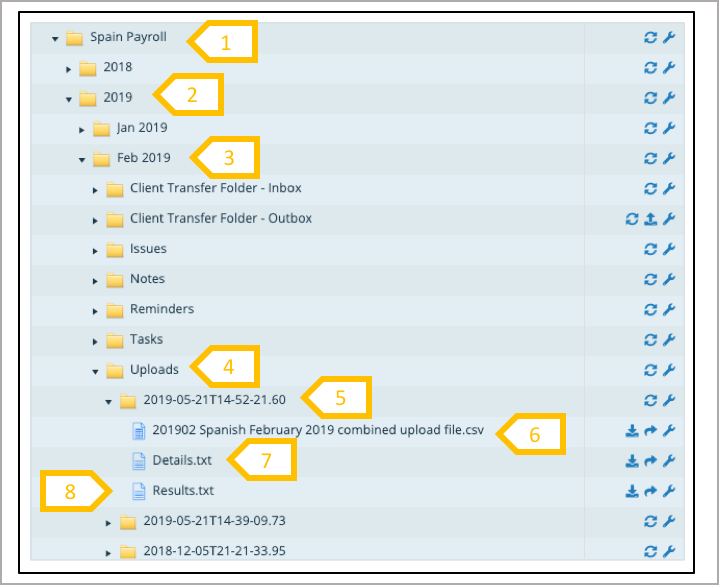
- Payroll
- Tax year
- Pay period
- Uploads folder
- Folder for upload
- Upload file
- Details – contains the upload instructions.
- Results – Lists the errors and successful upload of data
Multiple uploads
Multiple uploads can be performed for a payroll and pay period. Each upload will either add new data or overwrite existing data, or change a persistent value.
Adding new data – An upload could be acting on data elements which have not been included in a previous upload file, for example the first upload could be changes to salary and allowances, the second upload could be organisation unit changes.
Overwriting data – The pay value changes for a pay period, could be uploaded or reloaded. Any change made in the first upload could be overwritten (changed) by the subsequent uploads.
Updating persistent values – Organisation unit values are persistent, the system will carry forward the value to the next pay period. To end a persistent value enter #clear# in the data field for an employee, the system will have a null value against that employee.
When performing multiple uploads to a pay period it is important to run an all data report for that payroll and pay period to ensure all of the gross to net data is correct. When all of the data is correct, lock the period to prevent any other data from being uploaded.
Clear down
The clear down function allows for the deletion of pre-processing pay data, employee details and pre-processing upload mappings. The clearing down employee details or pay elements will delete all of the data for that period including the persistent values carried across from the previous period. On re-uploading of data, the first action performed by the system is to copy across the persistent values. During the upload process for a pay period, the system fixes the mappings from a column heading to a pay element, if the new upload file has column headings names which differ from the first upload, it may necessary to delete the pre-processing upload mappings, to create set of mappings.
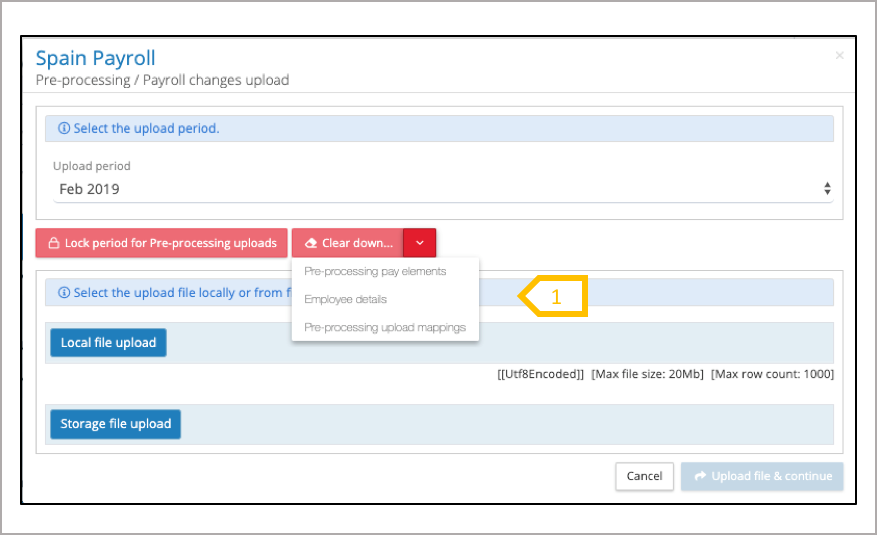
- Clear down has a drop down menu, enabling the user to select pre-processing pay elements, employee details or pre-processing upload mappings. Select the which of these to clear down, the system will return a message saying ‘are you sure’. Click yes to proceed with the action.